The Silver-Plated Label Does Not Tell the Whole Story
Learn how silver-plated and solid-silver objects differ in construction, wear and identification, so you can interpret a label without mistaking it for proof.
A silver-plated label describes a surface, not the whole object. On a serving spoon, candlestick or small urban shop find, that distinction affects what the eye can tell you: the visible silver may cover a different metal, while an object described as solid silver can still contain joins, fittings or repairs made from other materials.
“Solid silver” describes the material, not a single-piece object
Solid silver is commonly used to distinguish an object made from a silver alloy throughout its main body from one carrying only a silver coating. It does not mean that every component is silver, or that the object was formed from one uninterrupted piece. A teapot might have a silver body, a separately attached handle and a non-silver pin or hinge.
Silver objects are often made from an alloy rather than chemically pure silver, because a small amount of another metal can make the material more workable for everyday forms. The precise composition is a matter for a reliable mark, manufacturer information or specialist assessment; appearance alone does not settle it.
Look at the object as a constructed thing. A hollow handle, soldered seam, applied ornament or replacement component may be part of its design or later repair. None of those features, by itself, makes the main body plated.
Plating changes what wear can reveal
Silver plating is a thin surface layer applied over a base material. Depending on the object and its use, the underlying metal may become visible where the coating has worn through. Check edges, raised decoration, the underside of a foot, the inside of a handle and any spot that rubs against another object.
A colour change can be a clue, not a verdict. A warm or yellowish patch may suggest exposed brass, while a darker area could be tarnish, grime, an old coating or a shadow in the finish. Cleaning can blur the evidence: vigorous polishing may remove more surface material or make a worn patch harder to read.
Solid silver tarnishes too, and its surface can be scratched, dented or altered by repairs. A dark line is therefore not proof of plating, just as an even silver-coloured surface is not proof of solid silver. Read wear in context rather than treating one patch as a test.
Marks are clues with different jobs
Marks can identify a maker, indicate a standard of silver, show a place or system of assay, or describe a plated process. Their meaning depends on the mark itself and the conventions used for that object. A name stamped into metal is not automatically a silver-content mark.
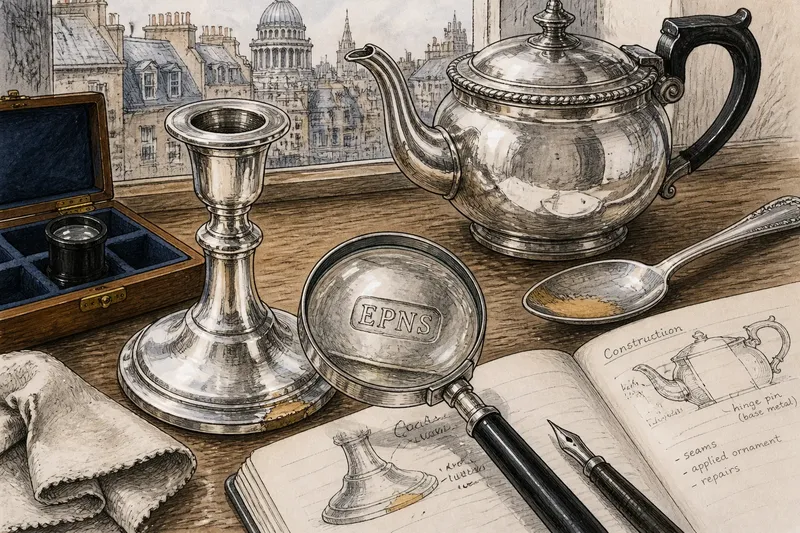
On British silver, familiar hallmark elements can include a maker’s mark, a fineness mark and an assay-office mark, though the combination and form vary. Plated goods may carry words or abbreviations such as “EPNS” or “silver plate”; these point towards plating, but a worn, incomplete or unfamiliar stamp deserves caution. Marks may also be copied, added later or confused with decorative lettering.
Use a magnifier and good light to record every mark before polishing. Note its position, lettering, surrounding symbols and relation to seams or decoration. A clear photograph can help a recognised reference source or qualified valuer assess it; do not force a confident reading from a smudged stamp.
What should you check before deciding?
Does a worn edge reveal another colour?
It may indicate that a coating has worn through, especially on a high point or contact edge. Compare several areas and consider dirt, old repairs and reflections before treating colour alone as decisive.
Can a magnet identify solid silver?
A magnet can help identify some iron or steel components, but silver is not magnetic and many base metals are not either. A lack of attraction does not distinguish silver from every possible substitute.
Do stamps such as “EPNS” mean the object is solid silver?
They generally refer to a plated material rather than a solid-silver body. Check the complete wording and the object’s construction, since stamps can be incomplete, worn or misread.
When is a professional opinion useful?
Ask a reputable silver specialist or valuer when a mark is unclear, an object may have significant value, or a purchase depends on its material. For the correct interpretation, defer to the relevant assay system, maker’s information or a qualified professional where those details matter.
Construction can make a simple inspection misleading
Some objects combine materials by design. A silver-plated tray may have a timber base or a felt-covered underside; a silver vessel can include a non-silver liner, handle or fastening. In either case, a different material at one point does not establish what the main body is made from.
Joins offer useful context. A seam can show how a hollow form was assembled, while solder around an applied ornament may mark a repair or original construction. These observations help describe the object, but interpreting a seam as proof of either plating or solid silver overreaches what the eye can establish.
Say you find a small candlestick with a worn foot, a bright upper stem and a stamped abbreviation you do not recognise. Photograph the mark, inspect the foot without scraping it, and describe the visible wear separately from your guess about the metal. That record gives a seller or specialist something concrete to assess without turning a hunch into a claim.
Care should preserve evidence as well as appearance
Before cleaning an uncertain object, remove loose dust gently with a soft, dry cloth. Avoid abrasive pads, scraping and aggressive polishing compounds, particularly where a coating may be thin or already worn. If the item has sentimental or potential commercial value, pause and seek advice rather than trying to expose a mark or remove tarnish by force.
Store pieces so metal surfaces do not grind against one another, and keep damp materials away from them. For an object with mixed materials, unknown coatings or delicate attachments, follow its maker’s care instructions where available; a method suitable for a plain silver spoon may harm a plated finish, lacquer, timber or textile.
The useful distinction is not simply “silver” versus “not silver”. It is a considered description of the main material, the surface, the marks and the parts that do not match. When reading a silver-plated label, keep those clues separate until they support the same conclusion.